
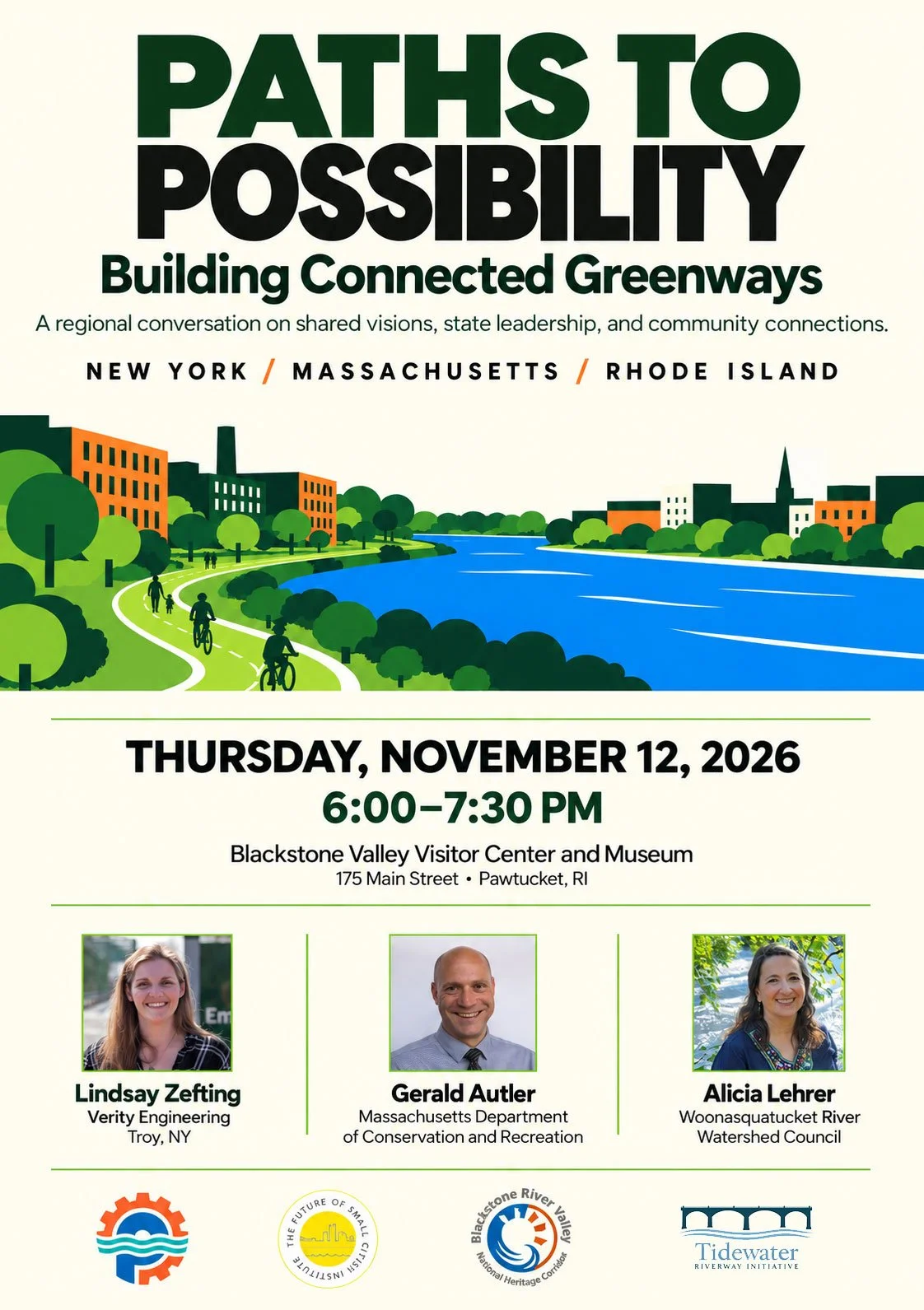
Paths to Possibility: Building Connected Greenways
A connected greenway can change how people experience a city—linking neighborhoods, opening access to rivers, and creating new places to gather. But building these pathways through an existing city means navigating a complicated landscape of industrial properties, busy roads, competing priorities, and overlapping jurisdictions.
How do we turn a shared vision into a continuous path?
This conversation comes as five cities join forces to close the seven-mile on-road gap between the Blackstone River Bikeway’s terminus in Cumberland and the East Bay Bike Path at India Point Park. Connecting these two regional routes presents an opportunity to rethink how we work across municipal boundaries—and who takes responsibility for bringing the missing links together.
As Pawtucket works toward completing the Blackstone River Greenway, join us for a conversation with three regional leaders working to plan, fund, and build greenways in New York, Massachusetts, and Rhode Island. Together, we’ll explore how state agencies, municipalities, nonprofits, property owners, and community members can move projects forward—and what it takes to close the most difficult gaps. Drawing on neighboring states’ experiences, we’ll consider how Rhode Island’s state agencies might take a more active leadership and ownership role in completing and managing the critical greenways that connect our communities.
The panelists are:
Lindsay Zefting, Principal Engineer and Planner at Verity Engineering in Troy, New York, will share lessons from her work helping deliver the 750-mile Empire State Trail. Drawing on experience with statewide trail networks and Troy’s industrial riverfront, she’ll explore how coordination, design, and local planning can turn disconnected segments into a connected system.
Gerald Autler, Director of Trails and Greenways at the Massachusetts Department of Conservation and Recreation, will offer a state-level perspective on building a network of trails. He’ll discuss how a public agency can lead planning, direct resources, and work with cities and towns to move projects from an idea to construction—and provide continuity and stewardship across municipal boundaries.
Alicia Lehrer, Executive Director of the Woonasquatucket River Watershed Council, will discuss the decades of partnership and community engagement behind the Woonasquatucket River Greenway, including its recently completed connection between Olneyville and downtown Providence. Her work demonstrates how a greenway can become an ecological, educational, and community crossroads, bringing together river restoration, flood resilience, and everyday access.
Through these three perspectives, we’ll examine what has worked, where projects get stuck, and how communities can sustain momentum over years of planning and construction. What could stronger state leadership make possible, alongside local initiative and community expertise? And how can completing the Blackstone River Greenway help reconnect Pawtucket to its river and to the wider region?
The panel will be moderated by Reif Larsen, of The Future of Small Cities Institute and will be followed by audience Q&A. Light refreshments will be served.